


Why is it important to have horses ridden correctly undersaddle?
- belisarifarms
- Jan 24, 2023
- 2 min read
Many riders search for the information to collection and many times can end up with false and ultimately harmful information resulting in poor performance and health of their horse over time.
True collection is achieved not only through developing the musculature of the horse but by the way we ride.
Often a horse can be seen ridden with a neck and head that is hyper-flexed or to the extreme rolkur. This training is seen through all disciplines, english or western. Hyper-flexion or incorrect placement of head and neck affects the cervical vertebrae, axis, (atlantoaxial joint) atlas, (atlanto-occipital joint), jaw and nuchal ligament.
Incorrect use of draw reins and tie downs encourage this harmful positioning of the horse in training.
Placing the horse in a state of tension throughout the head and neck will translate throughout the rest of the body.
Thoracic vertebrae and lumbar vertebrae will be put under strain resulting in musculature pain and necessary treatment before continuing work.
Here is a question. Which goes first, hocks or back?
The answer is back. Poor support of the back will directly affect the hocks. The best prevention for hock issues is early correct training!
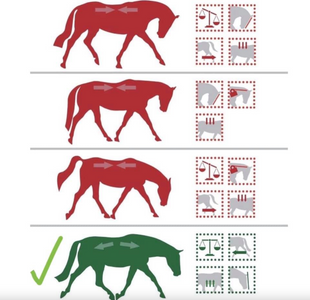
A good diagram showing why it’s important to ride back to front, while allowing the horse to relax and encourage self carriage.
The key to this is developing the abdominal muscles. The abdominal muscles are made up by the intercostals (external and internal), external and internal abdominal oblique and transverse abdominal. The longissimus dorsi, iliocostal and thoracic serratus are important too in protecting the back so should be developed.
By developing the abdominal muscles our horse is better able to achieve self carriage and advance to collection.
If you think of it this way, a person would never only work on arms and legs at the gym while completely avoiding their abdominal muscles. If a person were to do this, their whole body would suffer as they have no core strength to help maintain correct positioning.
The German Training Scale was created for this purpose, to guide riders in correctly developing their horses in a safe and effective way.
Collection is the final stage in the German Training scale and can only be achieved when previous stages have been mastered.
Stage 1 – Rhythm
Stage 2 – Looseness
Stage 3 – Contact
Stage 4 – Impulsion
Stage 5 – Straightness
Stage 6 - Collection
When a horse is correctly collected, the horse is relaxed and his hind quarters are engaged bearing more weight which enables the neck and forehand to be more elevated which presents uphill, rhythmic and impulsive movement. While in collection the poll will always be the highest point on the horse. A horse moving in this way will last longer and have a healthier, happier life than a horse put under constant tension, musculature pain and future joint issues as their bodies simply cannot handle it.







Comments